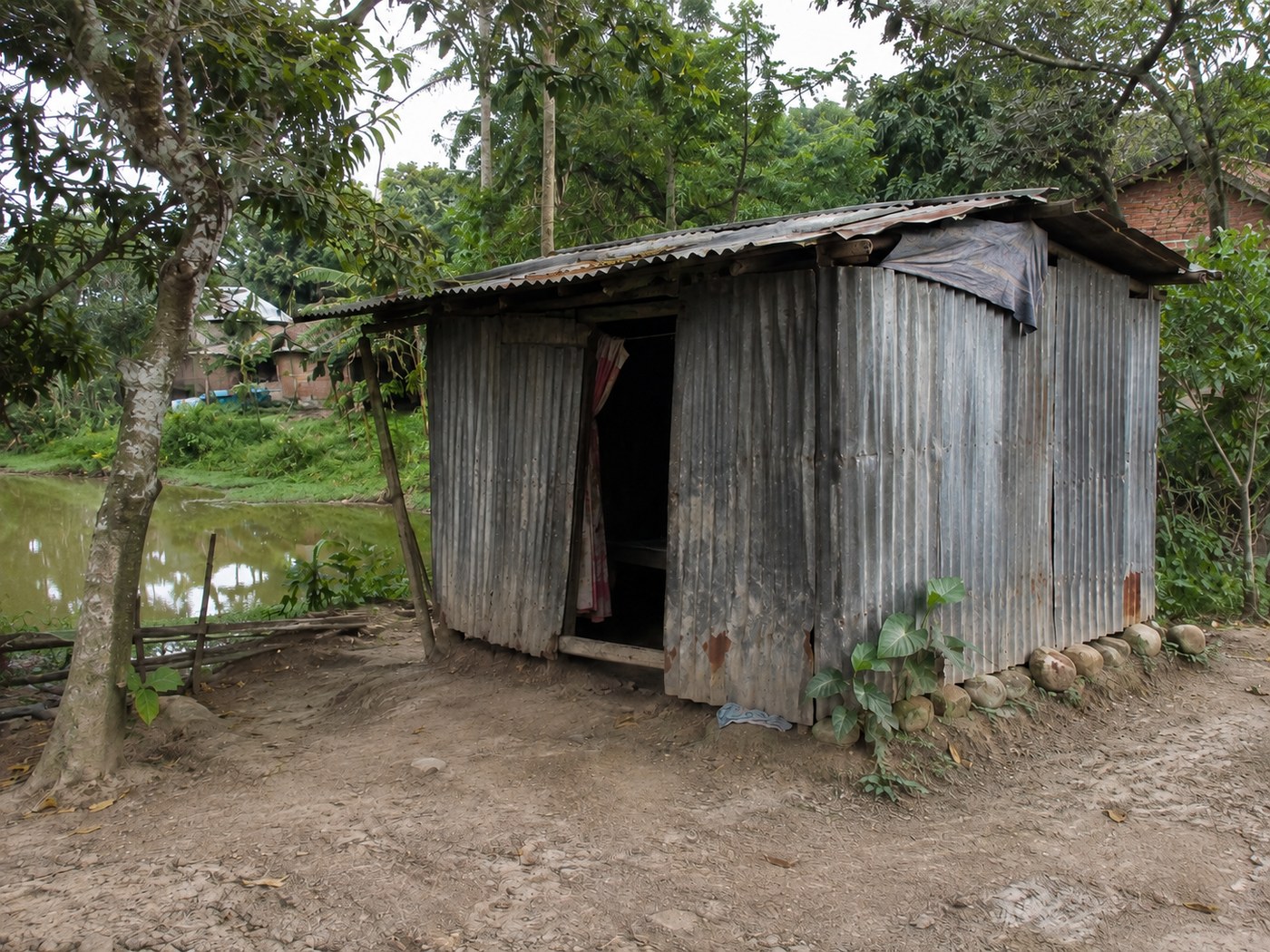
Ed Sheeran introduced you to the Lego House. Let me introduce you to the Tin House.
When I began writing my open diary, The Doctor’s Diary, I said I would be open and honest. So here goes.
I work in sustainable development. Over the years, people I have mentored have described me as polished, smiley, perhaps someone who appears to have everything together.
But life rarely looks on the inside as it does from the outside.
I certainly did not grow up feeling polished. My formative years were shaped by instability and poverty — poverty by UK standards, certainly, but poverty that still shaped how I understood money, security and responsibility.
Looking back, I realise my life and upbringing were quietly shaping something in me long before I had the language for it.
Equity.
I did not call it that then. I did not understand that the questions I was wrestling with were about fairness, access to resources and what people need to live with dignity. But those questions were already there.
Without realising it, equity was becoming woven into how I saw the world. Today it is something I am deeply passionate about, personally and through my work.
At the same time as our own household experienced financial difficulty, I would watch my father take telephone calls from Bangladesh, where our family originates.
Sometimes it was relatives. Sometimes people in the wider community.
Flood victims.
Families who had very little.
Someone whose tin house had fallen down.
And Dad would send money.
Sometimes hundreds of pounds. Sometimes collectively thousands.
Young Hushneara simply could not reconcile it.
I remember arguing with him.
Why were we sending money there when we needed it here? Why were people I did not know receiving money when our own household was struggling?
At ten years old, my understanding of fairness was simple: if we did not have enough, surely we should keep what we had.
Eventually my father would end the conversation with the same words:
“You talk about poverty. You don’t know what poverty is.”
That was his killer blow.
The room would fall quiet.
It took me around twenty-five years to understand him.
In October 2019, I travelled to Bangladesh for the first time since I had been born.
I thought I knew Bangladesh.
I spoke the language. I understood many of the customs. I had grown up amongst the Bangladeshi community in the UK and spent a lifetime hearing stories about the country.
But knowing a country through the memories of others is very different from standing in it yourself.
On the drive from the airport, I remember the colour, noise, movement and sheer energy of life happening around me.
But my eyes kept being drawn to something else.
Tin.
Tin houses.
Tin shops.
Tin walls.
Sheets of corrugated metal pieced together to form somebody’s home.
Some were rusted. Some were leaning. Some looked as though one violent storm might be enough to pull them apart.
Yet people were living inside them.
I remember a lump forming in my throat.
And somewhere in that moment, sitting in the car looking out of the window, my father’s voice returned:
“You don’t know what poverty is.”
For the first time, I understood.
He was not dismissing the difficulties we had experienced growing up. He was telling me that poverty has depths.
And I had only seen one layer of it.
I remember thinking about Maslow’s hierarchy of needs. At its foundation are our most basic human needs: food, water, shelter and safety.
Standing in Bangladesh, that diagram suddenly felt less theoretical.
There were people for whom the very bottom of that hierarchy was not assured. Shelter could be temporary. Safety could depend upon the weather. Basic security could not simply be taken for granted.
The Tin House
As I travelled through Bangladesh, the contrast became impossible to ignore.
There were stretches of road lined with what I jokingly called “Beverly Hills houses”: enormous homes, beautiful gates, sweeping driveways. Many had been built by Bengalis living overseas/ Diasporas.
Some even had their own private mosques.
And then, sometimes only a short distance away, I would see the tin houses again.
A mansion in the foreground.
A tin house somewhere behind it.
Two completely different lives occupying almost the same space.
Bangladesh was not without wealth. Wealth was visible.
The deeper question was who could access it.
Who had land?
Who had education?
Who could borrow?
Who had savings?
Who had connections?
Who had choices?
And who did not?
That is where the Tin House became more than a physical structure for me.
A tin house may consist of only a handful of sheets of corrugated metal fixed together to create walls and a roof.
It is resourceful in its simplicity, but fragile.
A family may sleep, eat, cook and live within one room.
A flood can take it.
A storm can take it.
For families who do not own the land beneath their home, vulnerability runs even deeper. There may be generosity in being allowed to build on someone else’s land, but there is also dependency.
Suddenly the Tin House begins to speak about much more than shelter.
It speaks about land.
Power.
Wealth.
Education.
Health.
Opportunity.
Choice.
Or sometimes the absence of choice.
During visits to communities connected to my father’s side of the family, people showed me homes he had helped rebuild after storms and floods. Others showed me more permanent houses he and relatives had helped fund.
They spoke with deep gratitude.
And I remember thinking about ten-year-old Hushneara.
The little girl who had argued so fiercely that we needed that money more.
I finally understood what Dad had seen from thousands of miles away.
When somebody calls because the roof over their family has disappeared, the conversation about who has “enough” suddenly looks very different.
What the Tin House Came to Mean
The Tin House stayed with me.
It followed me back to the UK.
And once I had really seen it, I began hearing about it elsewhere too.
After returning from Bangladesh, I spoke with a friend from Nigeria. As I described what I had seen, he immediately recognised the image. He spoke about people living in poverty in homes made from tin, including structures raised on stilts.
Others told me about similar homes in India and other parts of the world.
The geography changed.
The languages changed.
The communities changed.
But the story felt familiar.
The Tin House was not simply a Bangladeshi story.
It was part of a wider story about inequality, poverty and people building shelter from what they can access rather than necessarily what they would choose.
That made the image even more powerful to me.
The Tin House became less about one particular house in one particular village and more a symbol of lives around the world where basic needs, resources and security cannot be assumed.
It enters my thinking at the Centre for Sustainability because sustainability, for me, has never simply been about carbon emissions, technology, net zero or environmental targets.
Those things matter enormously.
But sustainability is also about people.
Whether someone has enough food.
Whether they have somewhere safe to sleep.
Whether a child can access education.
Whether a family can access healthcare.
Whether clean water is available.
Whether people have the resources to move beyond merely surviving.
Because what does sustainability mean to someone whose roof may not survive the next storm?
What does long-term resilience mean to someone worried about finding food tomorrow?
The Tin House deepened my understanding of equity.
Although, looking back, equity had been shaping me long before I ever encountered it.
My childhood had already taught me that people do not begin life from the same place.
Some begin surrounded by security, education, networks, capital and opportunity.
Others begin fighting for access to the most basic things.
Equity asks a harder question than equality:
What does this person actually need in order to have a genuine chance?
That question sits at the heart of much of the thinking we have been developing at the Centre for Sustainability.
For me, it is not simply a professional concept.
It is personal.
It is connected to the child I was, the family and environment I grew up in, the country my family came from and the Tin Houses I could not stop seeing.
Much of what shapes our lives is determined before we have any say in it.
Where we are born.
Who we are born to.
The systems around us.
Whether our parents have resources.
Whether education and healthcare are accessible.
So much can turn on what feels like the flick of a coin.
Any one of us could have been born into the Tin House.
If the roles were reversed — if we were watching people struggling to keep their tin houses intact, weathering the storm, choosing between food and medicine, or seeing our children’s opportunities limited simply by where they were born — we would hope somebody would see us.
Not pity us.
See us.
Recognise our dignity.
Recognise our potential.
And recognise that perhaps they were in a position to help change something.
For me, that is where responsibility begins.
Not from superiority.
Not from charity alone.
But from recognising our shared humanity.
Through the Centre for Sustainability and the wider Foundation work I want to develop, I think often about the responsibility of businesses, social enterprises, institutions and individuals with resources.
But responsibility must come with humility.
We cannot enter communities believing that because we have resources, we have the answers.
We have to listen.
We have to understand.
We have to build with people, not simply design solutions for them.
Perhaps that is why the Tin House still matters so deeply to me.
It began as something I first saw through a car window.
Then it became the answer to a childhood argument I had carried for twenty-five years.
And over time, it became something larger.
A way of thinking about poverty.
Dignity.
Access.
Power.
Equity.
And the responsibility that comes with having more than someone else.
The Tin House may look different in Bangladesh, Nigeria, India or elsewhere. It may stand on earth, at the edge of someone else’s land or above water on stilts.
But the questions beneath it are remarkably similar.
Who has access to resources?
Who has security?
Who has choice?
And what responsibility do the rest of us carry when we have the means to help widen that access?
I still see the Tin House.
I see it when conversations about sustainability become too detached from the realities of people’s lives.
And sometimes I still hear my father’s voice.
“You don’t know what poverty is.”
Perhaps none of us can fully know somebody else’s poverty.
But we can choose not to look away from it.
And I suspect that is why the Tin House will stay with me for the rest of my life.