This month is a special month as it’s the release of the first ‘Dr Sustainability’s Recommended Read’. This month is also my birthday (not relevant for this article but I thought I would share that with you anyway). Finally, not to forget, this month is the festive period for many, as well as the conclusion to an interesting year in the field of sustainability and climate action.
The first chosen ‘Dr Sustainability’s Recommended Read’ was always going to be quandary given the plethora of brilliant authors working currently in this arena. Notwithstanding, I was drawn to a text that assimilates with modern times and the need for systemic climate action.
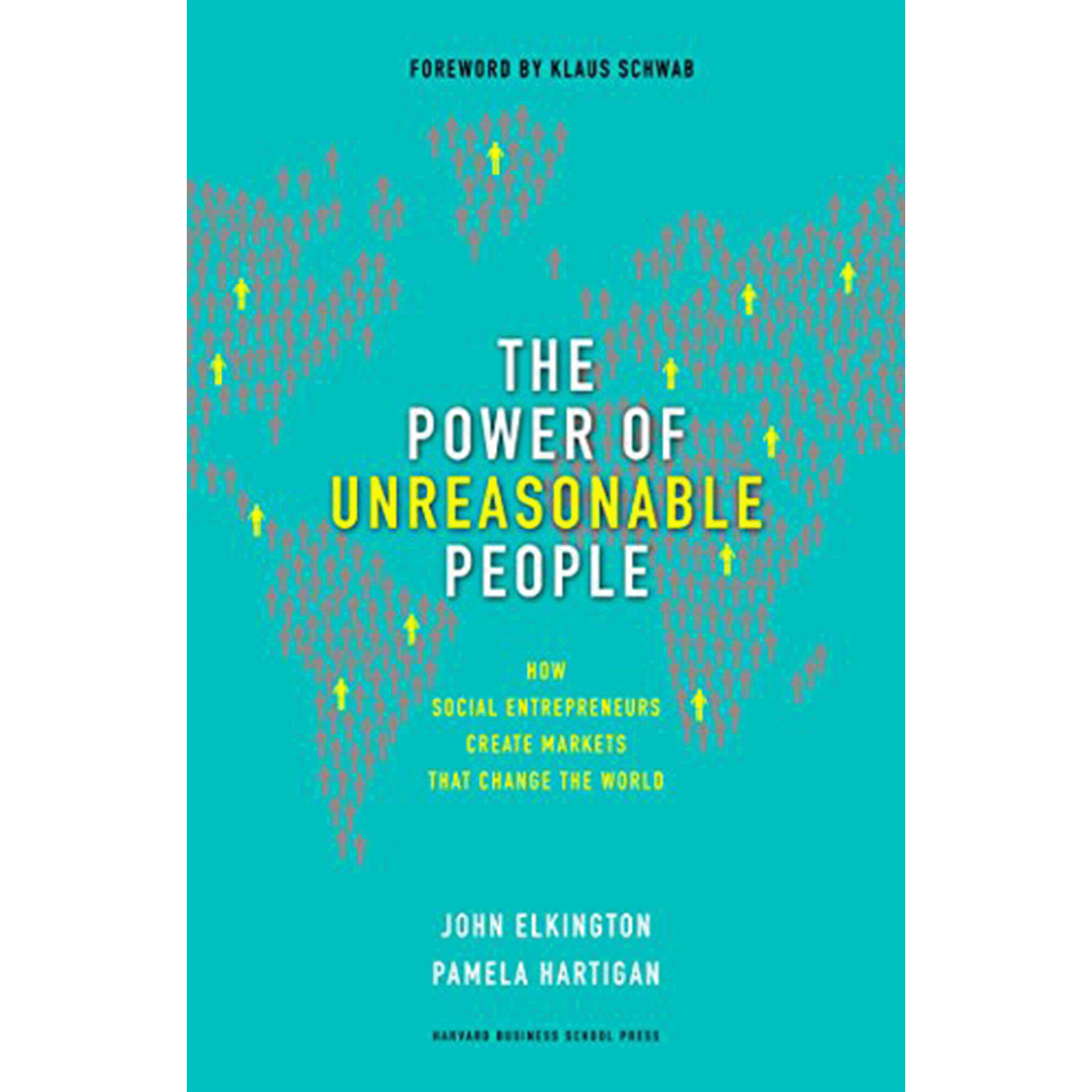
Without further ado, drum roll please…Dr Sustainability’s first Recommended Read (December 2022) is ‘The Power of Unreasonable People’ co-authored by John Elkington and the Late Pamela Hartigan.
Availability
The book is available via a range of reputable outlets including World of Books, Amazon, Oxfam and eBay. There are four second-hand copies available on eBay (as I publish this piece). I would encourage, where possible, to embrace the Reduce, Reuse, Recycle (i.e. the circular economy) concept by picking up a Kindle version, currently available through Amazon. Comparatively, the price on Kindle is disproportionately higher than a copy of the physical book. I’m not entirely sure why that is, nonetheless, I am sure there is a perfectly good explanation behind that, and whatever the case it will spare a few trees going down too.
The book and I
This book is one that has resonated with me. Time and time again it has given me the ‘get up and go’ energy with my own social enterprise. Starting up an enterprise isn’t easy, let alone a social enterprise. Some of what I want to achieve with the social enterprise appears alien to family, colleagues and friends. Pushing boundaries and trying to share a vision through murky, yet powerful glasses isn’t always easy. Then trying to create a vehicle that generates and re-invests back into society can be quite tough. This book has helped me and I hope it also inspires you to push boundaries for a better tomorrow.
The Book
The full title of the book is ‘The Power of Unreasonable People: How social entrepreneurs create markets that change the world’, published by Leadership for the Common Good, Harvard Business Press, Harvard University. The book was originally published in 2008 and remains relevant today. I would even go as far to say, it is more relevant than ever with the scale of action required within the sphere of climate change. The book title focuses on social entrepreneurship. The book is relevant for a range of audiences including budding social entrepreneurs, educators, those involved in transformation, individuals contributing to systemic change, procurers wishing to understand the value of social enterprises, as well as anyone who is intrigued by the dimension of social enterprise and sustainability today.
There are a couple of references, time specific, within the book such as the ‘Millennium Development Goals’, which a reader needs to bear in mind. A reader can easily refresh this for context, with the recent term: ‘Sustainable Development Goals’ (SDGs) set by the United Nations, without too much stress.
The Preface of the book opens with a reference to the playwright George Bernard Shaw, who once said “The reasonable man adapts himself to the world; the unreasonable one persists in trying to adapt the world to himself. Therefore, all progress depends on the unreasonable man.” This by definition, would mean some of today’s leading entrepreneurs and visionaries are undivided, unreasonable and a fair few may even be dubbed crazy.
As a whole, the book comprises of 242 pages and is used as a reference guide in the field. Early on, within the book you will learn what “social entrepreneurship” is, what characteristics social entrepreneurs share and how social entrepreneurship can advance the world. The authors outline from their own conversations with successful social entrepreneurs three primary factors: (i) legitimacy for their “unreasonable” models, (ii) access to networks of political, business and media leaders and (iii) capital. The book therefore neatly comprises itself in a matter that support this thinking. The book contains three key sections 1) Building Innovative Enterprise, 2) Creating the Markets for the Future and 3) Leading Sustainable and Scalable Change. With major challenges such as poverty and climate change there is a growing need for social entrepreneurship.
The authors outline that social entrepreneurship can radically restructure businesses and markets. Such entrepreneurs can be viewed as change agents, introducing systemic change, revolutionising business models for the future. Terms such as pioneers and disruptors have been used in the text to refer to them, given many have led or contributed to profound transformation.
Without telling you the meat of the book (which I am finding hard right now as I have a tendency to just want to do that…a bit like telling someone about the movie, while it plays), the book is packed with case examples of social entrepreneurs; how they have contributed, revolutionised and even introduced new industries to illustrate their contributions to the world. This includes Schwab Foundation for Social Entrepreneurship, an organisation that focuses on supporting and developing practitioners whose efforts have achieved transformational change. The text mentions, Dr Venkataswamy and the ARAVIND EYE CARE SYSTEMthat introduced a doorstep service and out-patient for eye care in rural India to support parts of society whom would otherwise would have gone without eye care they require, such as cataract surgery.
The work of Muhammad Yunus is covered within the book. Muhammad Yunus was awarded a Nobel Peace Prize for founding the Grameen Bank and pioneering the concept of micro-credit and micro-finance, which enabled for example women to become creditworthy and make improvements to our lives, the community around them and find an avenue out of poverty. Not to forget, the text covers the work of the Late Fazle Abed, who formed one of the largest social enterprises in the world: BRAC(the former Bangladesh Rural Advancement Committee) to fight poverty, illiteracy, and child mortality and to support women’s health and development, acting as a catalyst, creating opportunities for people living in poverty to realise their potential. As you navigate through the book, I hope, like me, you appreciate walking through the footprints of these giants and are left inspired to contribute for a better world.
Neatly the concluding chapter titled ‘Lessons for tomorrow’s leaders’ brings you back to take stock and step into the future. This not only uplifts you but simultaneously brings you back home with some level of direction if you hope to make an impact tomorrow. The book makes a fantastic read and is wonderful Christmas gift for yourself, a friend or family member that potentially has the power to contribute to revolutionary work.
Here’s a bit about the authors
The book is co-authored by John Elkington and the Late Pamela Hartigan. Individually and collectively, they have been visionaries in progressing sustainability and considered pioneers. I would firmly define them as heavyweights in the field of sustainability. I wouldn’t usually write a piece specifically on the authors, but I think it is only fair to do so here given the profound contribution they have both made within sphere of sustainability. In future, for further Recommended Read recommendations I will try to limit this section (sorry, I have got a bit carried away in this piece).
The Late Pamela Hartigan
The Late Pamela Hartigan founded and was the first director of the Schwab Foundation for social entrepreneurship, a Swiss-based organisation focused on building and supporting practitioners who want to achieve transformational change. During her life Pamela was a frequent lecturer on the topic of social entrepreneurship in the United States, Europe and Asia. She was the founding partner of Volans Ventures. Before her death she was Director of the Skoll Centre for Social Entrepreneurship at Saïd Business School, University of Oxford. A wonderful legacy for a pioneer in the field.
John Elkington
In terms of John Elkington, he is a leading authority on sustainable development. He was co-founder and past chairman of SustainAbility, a consulting organisation. At the time of the release of the book, ‘The Power of Unreasonable People’ was his 18th book (yes 18th – he must be just writing books all day). It is probably a good place to tell you now that I have a soft spot for this man, so I may rabbit on and for an average reader that isn’t interested in me paying homage to this man you may wish to drop off here and pick up with me next month for January 2023’s Recommended Read.
The Homage
For those still here, let’s get going … for those new to sustainability, John a little under 30 years ago, coined the Triple Bottom Line/TBL (People, Planet, Profit) business strategy, as a challenge for business leaders to rethink capitalism. It offered a radical new direction, as businesses adapted to stop focusing solely on profits and expand their focus to include improving the lives people and the health of the planet. As the years and now decades have gone by, John has openly expressed in a range of releases this radical goal has been largely forgotten, and “Triple Bottom Line” thinking has been reduced to a mere accounting tool, a way of balancing trade-offs instead of actually doing things differently. It seems we today continue to outstrip our planetary boundaries with no sign of slowing down. John with his strong feelings about the implementation of the Triple Bottom Line offered a management concept “recall.” Because when it comes to sustainability, the time has come to either step up, or to get out of the way. It seems crazy, for a concept to get recalled, but I just love the fact he just did that, how bold and honest is that! Well, John, if you are reading this (I can only hope you are), I completely understand where you are coming from, but I’ll be honest, we still love your Triple Bottom Line. It is a very easy depiction for an early learner of sustainability, which is still being used it in academia and industry as people grapple to take hold of sustainability.
I must be honest and let you know the extent of my (professional) relationship with John, a relationship he knows nothing about!! I follow his work, quoted him in my own work and think it would be fair to say I have stalked him in this virtual world (all very harmless), this is what I will tell the authorities should I get picked up for harassment. I think you can call me a fangirl, a groupie, if they exist in the sustainability domain…I’m not sure if academics have groupies like the popstars, but there are weirdos like me around, hey what else can I say!
What John has also shown many of us is that you can carve up a career that works for you, which can be a blend of academia and also other stuff, stuff like consulting, advising companies in the space. He has been an inspiration for me as I work and contribute in the space of sustainability through my own consultancy organisation. Since 1974 he has been working in the consultancy space. I have followed his work tracking him back to when he co-founded the ‘SustainAbility’ consultancy company, established in 1987. Very forward thinking given that the Brundtland Report defined sustainability in 1987. I wonder if he and his colleagues knew at the point of registration the ‘SustainAbility’ company, sustainability would have blown up into the international mainstream concept it is today with the likes of Elon Musk regularly referring to the concept in his own talks.
Going back to John’s career, I’ve followed his career, his move to setting up Volans, a consulting organisation. Industry leaders draw to him, yet he is humble he is as a human. Volans has a pet, a dog as a member of the team on the team’s page and then the John candidly has given himself the job title ‘Chief Pollinator’. You have to love that free spirited thinking in world full of stiff collars. When you start to unpack even the meaning behind the word ‘Chief pollinator’…it runs deep and very meaningful in-respect of implementing sustainability. Characters like John give drive and space for individuals like me coming through to be creative, be authentic and simply be who you are rather than living to the shackles of conformity, strait jackets, the business and professional world can pose on us. Part of all our offering in life is to do it from a place we can be ourselves, our authentic self. I see it to be the birthplace of creativity, it keep us connected with one another. I have gone on quite a bit about John, I did warn you I get like this when it comes to him. Hopefully John doesn’t read this and think this one seems just weird and question if he needs to tell his security team about this Dr Sustainability. Hopefully he reads it knowing the words are from a person that highly respects him, admires his work as well as his devote contribution to the sustainability community and wider society.